Menstrual cups: What, How & Why

Menstrual cups can be daunting, especially if you have never used tampons before. There are so many questions you have in mind. How will you insert it? How much blood will it hold? Will it leak? What if it slips out of your vagina? What if it gets stuck? Will it fit your vagina? Is it safe? We are here to clear all your doubts and help you have the breeziest menstrual cup experience. Read on for more information on menstrual cups.
What is a Menstrual cup and what are the benefits?
A menstrual cup is an affordable, eco-friendly and a safer alternative to menstrual hygiene products like tampons. Menstrual cups are silicone cups which are inserted into your vagina to collect period blood. It can be safely used for up to twelve hours after which you need to empty it, clean it, and then reinsert. Since a menstrual cup can be safely for up to ten years, it is also quite cheap as compared to buying tampons or pads every month! Sounds terrific, doesn't it?
Apart from being eco-friendly and affordable, menstrual cups also eliminate the period blood odour, hold more blood, do not disrupt the natural pH of the area and reduce the chances of infections linked to the use of tampons like Toxic Shock Syndrome. (Read more about TSS here)

Now, most of you probably have one
question in mind - HOW DO YOU INSERT A MENSTRUAL CUP? Let's find out.
How to insert a menstrual cup?
Inserting a menstrual cup is easy.
You just sanitise the cup, get into a comfortable position, fold the cup to
make the mouth smaller and insert like you would insert a tampon. You can use a
little lubricant if necessary but, in most cases, it's not required.
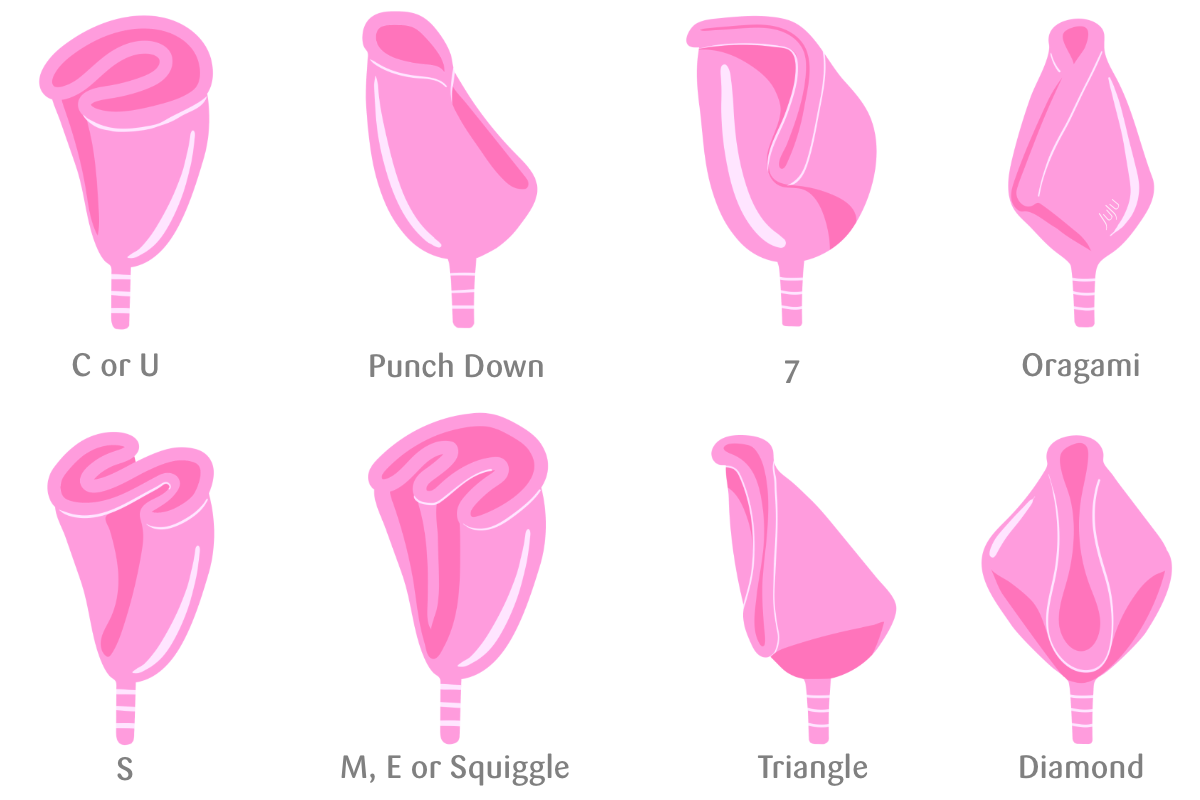
There are several types of folds
like the C-fold, U-fold, 7-fold etc. which you can use to insert a menstrual
cup. The most commonly used fold is the punch down fold as it provides the
smallest circumference for insertion of the cup.
You might be wondering, will it
fit you?
Menstrual cups come in various
sizes based on the amount of liquid it can hold and the length and the width of
the cup. Menstrual cups come in various sizes: Extra small
for teens, small for women who haven't given birth, large for women who have
given birth vaginally and so on. So, you can easily find one which fits you perfectly!
How to choose the right size?
While choosing a menstrual cup,
there are several factors you should consider: the position of your cervix,
your menstrual flow, pregnancy, and lifestyle.
POSITION OF THE CERVIX:
Now, you may think, how does the
position of your cervix affect the size of the cup you will use, but, let me
tell you, it matters. The position of your cervix affects the length of the cup
that you can use during your periods. It's best to measure the position during
your periods. To measure, simply insert your longest finger into your vagina
and try to touch your cervix. It should feel like the tip of your nose upon
touching.
If you can easily insert your
longest finger all the way up and still find it hard to reach the cervix, you
have a high cervix. In such cases, it's best to use a large or medium cup. For
low cervixes, opt for small cups. Choosing a cup based on the position of the
cervix will minimise the chances of the stem or the cup coming out of the
vagina.
MENSTRUAL FLOW:
Most cups can hold about 15 to 30
ml of blood. Depending on your flow and needs, you can choose a menstrual cup.
Go through the description of the cup carefully to find out how much blood it
can hold and select accordingly.
PREGNANCY:
Giving birth vaginally can cause
vaginal muscles to loosen up. This may cause the cup to slip or not be as
secure; therefore, you should choose a large cup. You should try out different
products to figure out which one works for you well.
LIFESTYLE:
Girls who are more active or work
out often have tighter vaginal muscles. You should opt for a hard cup instead
of the soft one to ensure the cup it is opening and keeping its shape inside
your vaginal canal.
The sizes of the cups can also vary
depending upon the brand you are using. So, make sure to read the description
very carefully before purchasing one.

Now that we have learnt how to
select, fold, and insert the cup, let us see how to make sure it is leak-proof
and how to tackle other related problems. Read on to find out.
#1 - YOU CAN FEEL THE CUP
If the stem of the cup is poking
out, or you can feel it, the cup is definitely longer than your vaginal canal,
and you need to opt for a shorter cup. A menstrual cup is correctly inserted
when it fits entirely into the vagina, and you cannot feel it at all!
#2 – YOUR CUP IS LEAKING
If your cup is leaking, chances are
it did not open properly and didn't attach to the vaginal walls. To check if
your cup has opened all the way, insert a clean finger into your vagina and run it around the base of your cup. If it feels like it is still folded, push onto
the folded area and it should pop open.
There are several reasons other
than your cup not opening properly, which can lead to the cup leaking. Firstly,
your cervix could be too low for the cup. Secondly, the cup could be too small
for you, and lastly, it could be too soft for you. All these problems can be
fixed by buying a different sized or type of cup.
#3 – YOU CAN'T REACH YOUR CUP
If you have a very high cervix and
you use a small cup, chances are you will find it difficult to reach the cup.
If this is the case, switch to a bigger sized cup.
BY
HEENA GUPTA


Very informative and persuasive piece of writing. It cleared many doubts of mine about menstrual cups.
ReplyDeleteVery good post. Highly informative for women. Keep up the good work.
ReplyDeleteWell researched
ReplyDelete